The story behind the museum
From Florence’s government offices to an art museum
The name “Uffizi” literally means “offices.” Its story begins with political power, long before the building became famous for paintings.
011560
Cosimo I commissions new offices
Cosimo I de’ Medici, ruler of Florence, wanted to bring important civic and administrative offices together. He commissioned architect Giorgio Vasari to create a grand building near Palazzo Vecchio, the seat of government.
Why it mattersVasari designed it for administration and authority—not originally as a museum.
021565
A remarkable passage above the city
The Vasari Corridor was built to link Palazzo Vecchio with the Pitti Palace area via the Uffizi and Ponte Vecchio. It allowed the ruling family to move between the government centre and their residence.
Know before visitingThe Vasari Corridor is a separate experience with specific entry rules; ordinary Uffizi admission does not automatically include it.
031580s
Francesco I develops the gallery
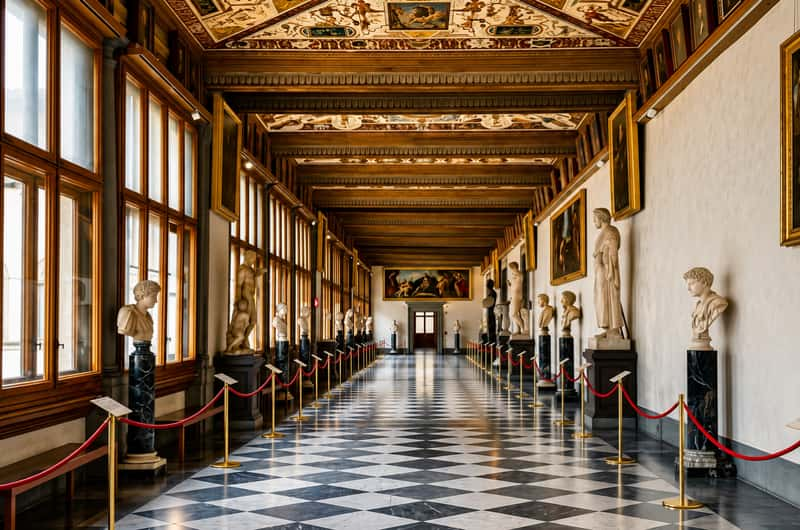
The main building was finished in 1580 after work continued under Cosimo’s successor Francesco I. The upper galleries increasingly displayed Medici treasures. The octagonal Tribuna, created in the 1580s, became a celebrated room for exceptional objects.
Look forThe contrast between practical office architecture and richly decorated collection spaces.
041737
The Medici collection stays in Florence
Anna Maria Luisa de’ Medici, the dynasty’s last major heir, agreed that the family’s important collections would remain connected to Florence and Tuscany. This agreement helped preserve the city’s artistic inheritance.
Why it mattersMany works remained together in Florence rather than being dispersed elsewhere.
051769
The Uffizi becomes a public museum
Under Grand Duke Peter Leopold, the Uffizi was opened to the public as a museum in the modern sense. Certain travellers and selected guests had seen the collections earlier, but this marked an important change in public access.
Remember1769 is the landmark date for the public museum—not the date when collecting began.
06Today
A museum that is still evolving
Curators, conservators and historians continue to research and protect its paintings and sculptures. Displays can move, and individual artworks or rooms may be unavailable during restoration, loans or renovations.
Visitor tipCheck the official website for temporary closures before planning your route.