Inside
10 masterpieces to plan your visit around
The collection is hung roughly in date order, starting on the second floor with medieval gold-ground altarpieces and continuing to the 17th century on the first floor. Follow that order and the story of Renaissance art unfolds in front of you.
01Where it starts
Three giant Madonnas by Cimabue, Duccio and Giotto
Near the start of the route, three huge altarpieces of the Virgin and Child hang side by side. Painted between about 1280 and 1310, they show art moving from flat gold patterns towards solid, believable figures, with Giotto taking the biggest step.
Simple testLook at the Virgin’s knees: in Giotto’s version they finally feel like real legs under the cloth.
02Early Renaissance
The Duke and Duchess of Urbino by Piero della Francesca
Two portraits face each other in profile, with tiny, detailed landscapes behind them. Federico da Montefeltro is always shown from his left side because he lost his right eye in a tournament.
Look closelyThe painted landscapes behind the couple seem to stretch for miles.
03Must see
Botticelli’s Primavera
Painted on wood in the early 1480s, this garden scene is filled with mythological figures and around 500 identified plants and flowers. Read it from right to left: the wind god Zephyrus chases the nymph Chloris, who turns into Flora, goddess of spring.
Botticelli roomsIt hangs next to the Birth of Venus, so you can compare them side by side.
04Must see
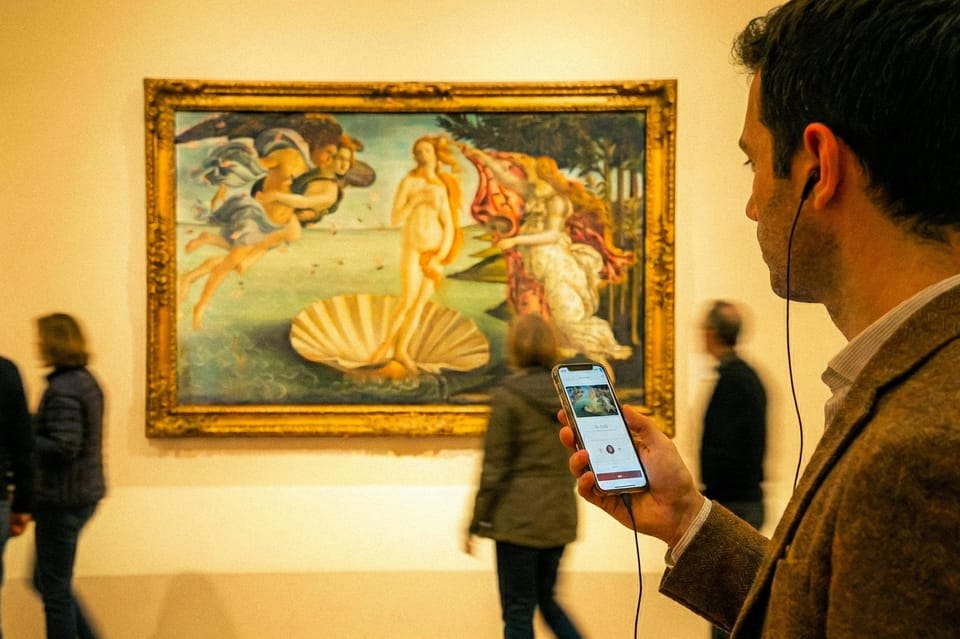
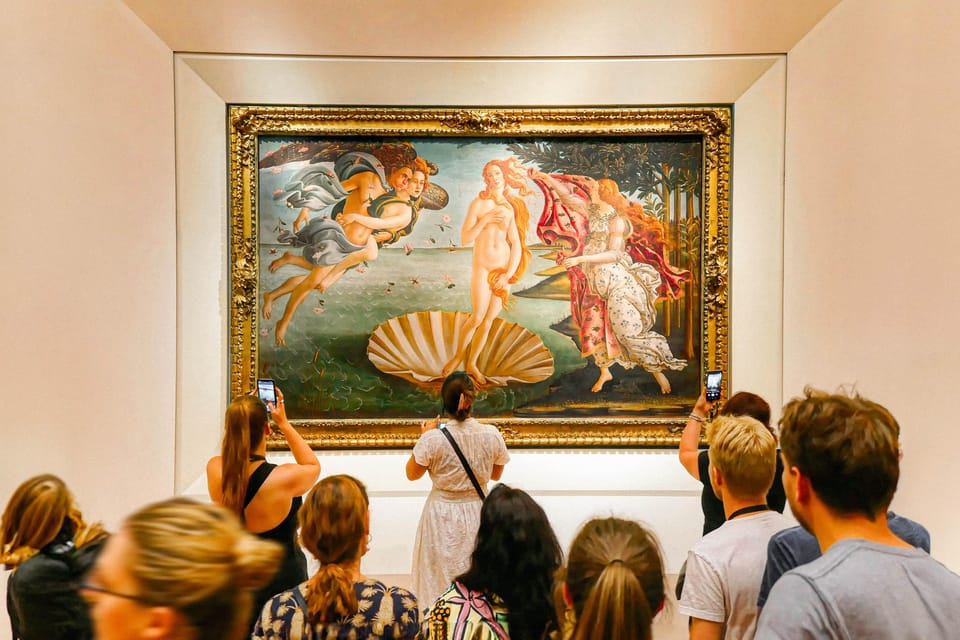
Botticelli’s Birth of Venus
Probably made for the Medici around 1485, this is painted on canvas rather than wood, which was unusual for such an important work at the time. Venus arrives on a shell, pushed by the winds, while a young woman waits with a flowered cloak.
Hidden detailThe orange trees on the right are thought to be a play on the Medici name.
05Leonardo
Leonardo’s Annunciation and Adoration of the Magi
The Annunciation is one of Leonardo’s earliest works, painted in the workshop of his master Verrocchio. Nearby, the unfinished Adoration of the Magi lets you see his drawing and planning under the paint.
Detail to findThe angel’s wings were painted like a real bird’s, not a decorative pattern.
06Michelangelo
Michelangelo’s Doni Tondo
This round painting of the Holy Family is Michelangelo’s only surviving finished panel painting. It was made for the wedding of Agnolo Doni and Maddalena Strozzi, and still sits in its original carved frame.
Pair it withRaphael’s gentle Madonna of the Goldfinch, displayed nearby, shows the rival style of the same years.
07Architecture
The Tribuna, the Medici treasure room
Built by Bernardo Buontalenti in 1584 for Grand Duke Francesco I, this octagonal room has a red velvet wall covering and a dome lined with mother-of-pearl shells. The ancient Medici Venus statue stands in the centre.
Good to knowVisitors view it from the doorways to protect the floor.
08Venice
Titian’s Venus of Urbino
Painted in 1538 for the Duke of Urbino, this reclining nude in a Venetian bedroom became one of the most copied images in Western art. It shows the warm colour and soft light that set Venetian painting apart from Florence.
Look behind herTwo maids search a chest in the background, giving the scene an everyday feel.
09Dramatic
Caravaggio and Artemisia Gentileschi
On the first floor, the mood changes completely. Caravaggio’s Medusa, painted on a round parade shield, captures a scream in the moment of death. Nearby, Artemisia Gentileschi’s Judith Slaying Holofernes is one of the most powerful works by a woman artist of the 1600s.
Before you goSome first-floor rooms close for rearrangement, so check the notices.
10Easy to miss
The corridors and the Arno view
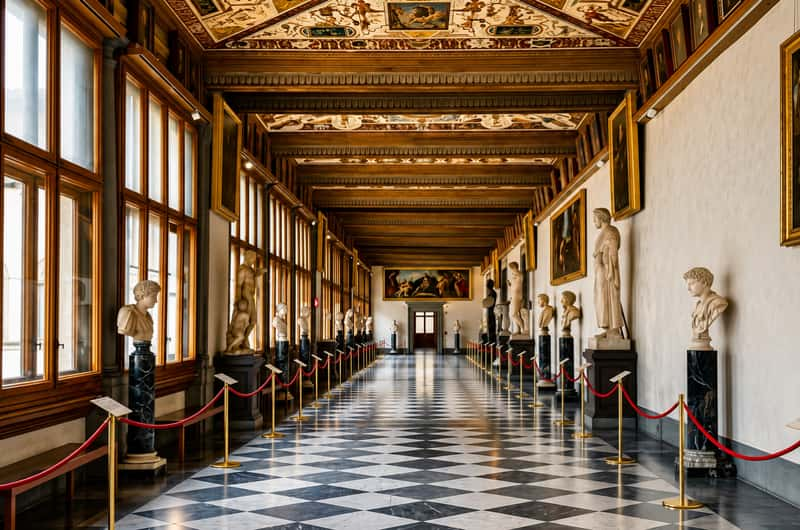
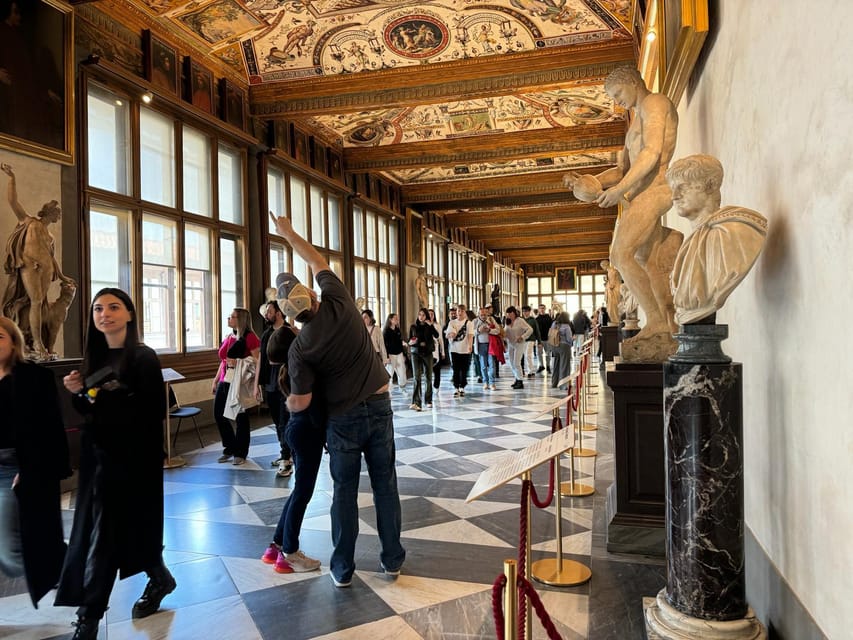
The long corridors are lined with ancient Roman sculpture and painted ceilings. At the river end, the short connecting corridor gives one of the best views of the Ponte Vecchio, with the Vasari Corridor running above the shops.
Take a breakThe rooftop café terrace above the Loggia dei Lanzi looks straight at Palazzo Vecchio.